hey all,
Lots of news. After my previous school bit the dust, I have finally found another job at a different company. It is a much larger company than I have worked at before, which has taken some getting used to.
I stopped working on Particularly Wavy for a few weeks and tried to get more work done on the item and questing systems for my RPG dream project. There are still quite a few issues to iron out and develop, but overall I think it was time well spent. I have since then resumed work on Particularly Wavy, and have got an Android version up and running, and gotten the puzzle count up to 65+!
I also tried to develop another game for a game jam about destruction, but I was not able to make the deadline and I'd say that the game is more or less dead on its feet. I wanted to make a game about being a frost giant in a frozen wasteland who pees and snow structures to destroy them, but I was unable to get some nice procedurally generated meshes working. I was able to generate some images using metaballs, cellular automata and Perlin noise, but I just couldn't get the fucking meshes to work correctly.
Besides, all of that, I've been playing through The Witcher 3: Wild Hunt for a second time in order to write a game analysis of it. I've also started Antichamber, and heaven forbid, I actually downloaded another fucking Ubisoft game: Tom Clancy's Ghost Recon Wildlands, which is somehow simultaneously a technical marvel and almost the most boring open world sandbox third person shooter ever developed.
I hope to get these posts back on their regular schedule starting this week.
Thanks for reading!
Wednesday, April 4, 2018

Thursday, February 1, 2018
February First Update for Particularly Wavy
Hey all,
My oh my, what a busy week. I've been watching a lot of GDC videos about adding feedback to one's games, and I've realized how poor a job my games do at this, so I've been programming some sound effects to play when you click objects, more sound effects that play when you move or rotate them, and even more sound effects that indicate if you hit the target with the correct color of light.
I've also been tracking down more bugs dealing with light filter game objects and targets, since although I already coded them, I did not have them working correctly for all situations. Finally, check out the video showing the improved shadow shader and the sound effects.
Besides that, I've been getting my computer ready for a clean install of Windows 10. Since November, I've been suffering through endless looping and re-downloading and re-installing of the same 2 or 3 Windows 10 updates, 2 of which were "successfully" installed more than 20 times. Last month I went so far as to disable the Windows 10 services that were running in the background and causing all these downloads, etc. But that seems to have effected a lot of other systems, and although my computer still runs pretty well, I'd like to get things properly updated.
My oh my, what a busy week. I've been watching a lot of GDC videos about adding feedback to one's games, and I've realized how poor a job my games do at this, so I've been programming some sound effects to play when you click objects, more sound effects that play when you move or rotate them, and even more sound effects that indicate if you hit the target with the correct color of light.
I've also been tracking down more bugs dealing with light filter game objects and targets, since although I already coded them, I did not have them working correctly for all situations. Finally, check out the video showing the improved shadow shader and the sound effects.
Besides that, I've been getting my computer ready for a clean install of Windows 10. Since November, I've been suffering through endless looping and re-downloading and re-installing of the same 2 or 3 Windows 10 updates, 2 of which were "successfully" installed more than 20 times. Last month I went so far as to disable the Windows 10 services that were running in the background and causing all these downloads, etc. But that seems to have effected a lot of other systems, and although my computer still runs pretty well, I'd like to get things properly updated.
Thursday, January 25, 2018
Particularly Wavy Jan 25 Update
hey all,
What a weird, wonderful week! I've been designing some more puzzles for Particularly Wavy, and also adding some more mechanics. In particular, I've added one-way glass and several varieties of portals.
Please check the video for more details.
What a weird, wonderful week! I've been designing some more puzzles for Particularly Wavy, and also adding some more mechanics. In particular, I've added one-way glass and several varieties of portals.
Please check the video for more details.
The Witcher 2: Assassins of Kings Analysis
The Witcher 2: Assassins of Kings Analysis
January 25, 2018
1 Overview
The Witcher 2: Assassins of Kings is an action RPG title developed and published by CD Projekt RED in 2011. It is the sequel to the 2007 game The Witcher, and was followed by The Witcher 3: Wild Hunt in 2015. This trilogy is based on a series of novels and short stories by the Polish author Adrzej Sapkoski.
2 Formal Elements
2.1 Players
The Witcher series are all single-player games. In them, the player takes on the role of Geralt of Rivia, a famous witcher. In Sapkowski’s fantasy world, witchers are people who have been genetically mutated and trained in order to hunt dangerous monsters. The Witcher 2 picks up an unknown amount of time after the events in The Witcher. Geralt has lost his memory previous to the events of The Witcher, and a main plot point in The Witcher 2 is Geralt attempting to regain his memory.
2.2 Objectives
The player is tasked with uncovering the mystery of Geralt’s missing memories. To achieve this, he will become entangled in a political assassination, a conflict between several human kingdoms and an alliance of non-humans struggling for freedom and equal treatment, and of course hunt monsters.
2.3 Rules
Like many RPGs, The Witcher 2 features a complicated rule set.
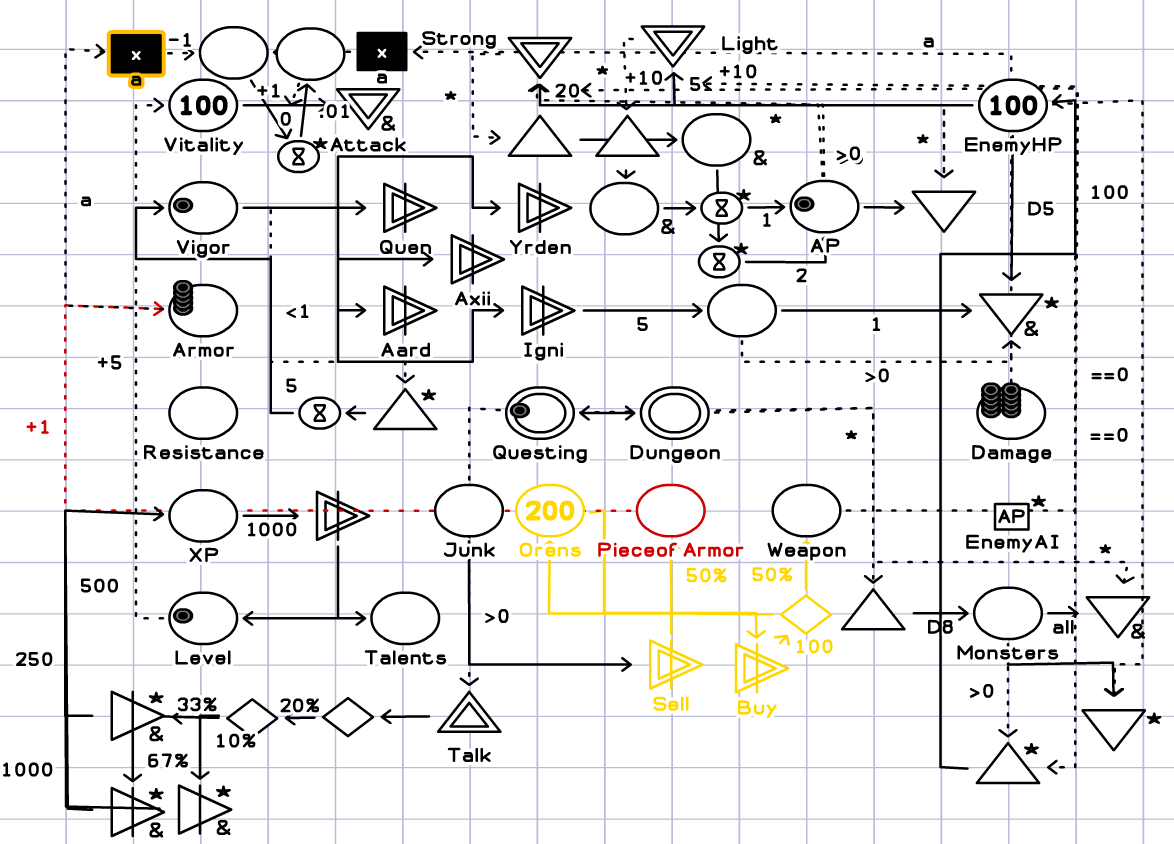
2.3.1 Items and Inventory

Geralt may interact with and pick up a great number of items. Weapons and armor from defeated enemies may be picked up and equipped, as can body parts from fallen monsters, flowers and herbs from plants, and random bric-à-brac.
Witchers use two swords, a steel sword for humans, and a silver sword for monsters. Geralt always has both equipped, and the player may upgrade them using rune stones, by finding better ones, or by crafting them using diagrams and crafting components at a blacksmith shop.
Boots, leggings, gauntlets, and body armor may similarly be equipped, upgraded, and crafted.
Herbs and monster parts can be used to make alchemical potions which give Geralt different abilities, such as regenerating his health, making his blood poisonous to vampires, allowing him to see in the dark, and many others. Monster parts and the bric-à-brac may also be used in a complicated crafting system: leather may be crafted by taking cloth, oil, and necrophage skin and combining them together. Leather itself may be used as a component to create items such as leather jackets, boots, etc, or it can be further crafted into Hardened leather by adding more oil.
All items, including armor and weapons, have weight. If the weight of the items Geralt is carrying exceeds his weight limit, he will be unable to run, and during combat he will be unable to roll or dodge.
2.3.2 Stats and Leveling
Geralt has several stats, which include: Damage, Armor, Vitality, Vigor, Adrenaline, Resistance, Critical Effects, and Knowledge.
- Damage indicates how much an attack by Geralt will reduce an enemy’s Vitality. This is a range, as all weapons have slightly randomized damage.
- Armor blocks damage from enemy attacks. The higher the rating, the more damage is be blocked.
- Vitality is the amount of health Geralt has. When his Vitality reaches 0, he dies and the game must be reloaded from a previous save. Potions and abilities can increase vitality regeneration outside of and during combat.
- Vigor is how many times Geralt may use a magical sign in a row. One use costs one Vigor, but potions and abilities can increase Vigor regeneration during combat.
- Adrenaline is a meter that is filled by engaging in combat. Potions and abilities can increase its generation. When the Adrenaline meter is full, a special ability can be used.
- Resistance comes in many flavors. There are bleeding, incineration, and poison, among others. Increasing resistance to one of these damage types will increase the percentage of the blocked damage.
- Critical Effects are the opposite of resistances: they indicate how much freezing, incineration, poison, or magic damage Geralt will inflict on enemies.
- Lastly, there is knowledge. Geralt can talk to NPCs, read books, and of course kill monsters himself. Through these means, he can gain knowledge about monsters. Some quests are locked behind knowledge gates (requiring a knowledge level of two or three, for example), and in any case, reading the books will give the player clues about what kind of oils, potions, signs, or fighting styles may be most efficacious against his foes.
2.3.3 Combat and Magic
Combat in The Witcher 2 has a reputation for being difficult and unforgiving. Patience and preparation are highly rewarded, to be sure. Potions cannot be drunk in the middle of combat, so if the player sees a group of monsters or soldiers in the distance, it would be best to apply an appropriate oil to one’s sword, make sure good bombs are equipped, and drink Swallow or another potion to boost his abilities.
As mentioned before, Geralt has two swords, one for killing humans and one for killing monsters. If the wrong sword is equipped, minimal damage will be dealt, but Geralt can switch between swords relatively quickly. In God of War-fashion, he has a strong but slow attacks and weak but fast attacks. Unlike God of War, these cannot be chained into combos, but the game system instead animates Geralt as best it can into a whirling slashing god of death. Geralt has bombs, throwing knives, traps, and signs at his disposal during combat. Geralt has five magical signs: Quen, Igni, Yrden, Axii, and Aard. Quen acts as a magical shield, protecting Geralt from a single blow, while Igni is the stereotypical fireball, Aard works as a Jedi Force push, Yrden is a magical trap, and Axii functions as a Jedi Mind Trick, possibly turning one of your enemies against his companions.
Similarly in some ways to the Souls series, Geralt takes damage pretty easily. Because of this, the player must dodge and parry successfully, besides using his magical signs effectively, in order to succeed.
2.3.4 NPCs
There are a great many NPCs in the game, and similarly to those in the book series, they seem to delight in all being assholes. Some of these may be killed, but many may not be attacked under any circumstances. Geralt may interact with many by entering dialogue, during which they will say something and Geralt typically has to choose between several different responses. Sometimes, these may all be spoken, but at times they are mutually exclusive.
Besides its uses in combat, Axii can also be used during specific dialogues to affect the outcome.
2.3.5 Areas
Although in some ways more open than The Witcher, The Witcher 2 prevents Geralt from climbing or moving around in many places that he should be able to reach. These restrictions come from level design considerations, engine limitations, and story telling concerns. Expect to meet many, many invisible walls, insurmountable logs, rocks and ledges, and water that apparently repels witchers. Besides these limitations, there are three distinct areas, plus a prologue, and while the player may explore each area, the player may only progress from one area to the next in linear fashion, with no backtracking allowed.
2.4 Procedures
2.4.1 Exploring

Although not a large open world, The Witcher 2 nevertheless features three relatively large areas. There are fields, forests, ravines, caves, ruins and more for the player to navigate. The Witcher 2 does have a game map and minimap, but the game map can only be accessed through a menu, and the minimap is zoomed up so close as to be of limited use. Further, the level design makes navigation quite difficult, as forests have areas of impassable rocks or shrubbery, and and fields might have cliffs or other obstacles which are not clearly marked on the map, and are not clearly player-readable in the game world.
The game world is a joy to behold, even if it is not a joy to get around in. Talking to NPCs and finding evidence of current or past inhabitants or past events feels like coming across such in the real world.
2.4.2 Talk to NPC
Conversations in The Witcher 2 are something like those in real life. Although of course limited in the number of options which the player may broach, the NPCs sometimes do not wait around passively for the player to make a choice: sometimes there is a time limit for the player to choose. The NPCs also do not always tell the truth, so you need to be careful who you believe. The player’s choices during dialogue have quite profound effects on the game world: a pivotal decision at the end of the first chapter, for example, sends the player to one of two completely different locations, with different NPCs, quests, story lines, and decisions to make there.
2.4.3 Leveling and Upgrading
The Witcher 2 has a deep and complicated leveling system. Geralt gains XP by killing enemies and by completing quests. The game designers have made a choice to limit the amount of XP Geralt gains by killing enemies; instead, the player will have to complete main quests and side quests to gain the most XP. Killing a monster or soldier may grant 0 or 11 XP for example, while completing a quest could grant 200 or up to 2500 XP.
For each 1000 XP Geralt collects, he will gain a level and one talent point to spend on abilities. He has four ability trees: Training, Magic, Swordsmanship, and Alchemy, but the player must invest the first six points in Training before unlocking the other three. Further, the roots of Magic, Swordsmanship, and Alchemy must be unlocked before progressing further in each tree.

2.4.4 Questing
The player will spend most of the game completing quests. These typically require the player to speak with several NPCs to gather data what he is dealing with, investigating a scene by using his witcher senses, gathering more information from books, etc. There are usually several ways to complete a quest, and they often lead to very different results.
2.5 Resources
2.5.1 Abstract
- Vitality: described above
- Vigor: described above
- Damage: described above
- Armor: described above
- Adrenaline: described above
- XP: described above. After each level up, this is reset to zero and any remaining XP is added.
- Level: an integer which indicates Geralt’s overall power. Each level up adds 5 to Geralt’s Vitality.
- Resistances: described above
- Knowledge: knowledge comes in three levels, each of which grants Geralt a further bonus against that particular kind of monster.
- Talents/Skills: After each level up, Geralt is granted one talent to spend on a skill.
- Toxicity: the amount of poison due to drinking potions. This decreases over time, but can lead to reduced damage, vitality or vigor during combat.
- Weight: All items have a weight, although for certain items this is 0. Their combined weight contributes to Geralt’s encumbrance, which influences whether he can run and roll.
2.5.2 Physical
- Weapons: The Witcher 2’s combat focuses on the use of steel and silver swords, but there are a few other weapons, such as axes, pickaxes, and throwing knives. These all have weights, damage ratings, and values. Some items have additional slots that the player can place runes or other upgrades in.
- Orens: Orens are the money of the Witcher universe, at least for many of the countries.
- Armor: Geralt can wear many different kinds of armor, and like weapons, they all have weights, blocked damage ratings, values, and other properties, such as generating adrenaline or increasing resistance to magic damage. Some items have additional slots that the player can place runes or other upgrades in.
- Trophies: When killing monsters, Geralt can sometimes collect trophies from them. These are worn on his belt, and grant bonuses depending on the monster.
- Crafting Items: There are a great many crafting items, some of which are crafted from other more basic ones. Like all other items, they have weight and value. Alchemical crafting items additionally have one or two elements associated with them, which determines how they are used to make motions.
- Potions: Potions are made from alchemical crafting items, and give Geralt different bonuses and penalties, in addition to increasing his toxicity.
- Bombs and traps: Bombs and traps are crafted like all other craftable items, but during combat these can be thrown or placed on the ground. They are necessary to complete certain quests or activities, such as destroying nekker nests.
- Mutagens: These are items collected randomly from certain monsters, which can be used to augment or mutate some of Geralt’s abilities. They may give him bonus critical damage, increased Vitality regeneration, or some other special stat.
- Companions: Throughout The Witcher 2, Geralt will be accompanied by an NPC. Sometimes he will have to protect them, and will either fail the game or fail the quest if they die.
- Diagrams and Recipes: These are necessary to create new items, bombs, and potions.
- Books and Notes: These play a critical role in learning about the world, its backstory, and also in completing quests and learning how to perform certain rituals throughout the game.
2.6 Conflicts
2.6.1 Stat Point Investment
There are over 100 abilities to unlock in The Witcher 2, but the level cap is 35, so the player can only ever unlock 34 abilities during gameplay, and therefore must invest talents carefully to most effectively match their playstyle.
2.6.2 NPCs
Perhaps more than most other games, the Witcher series thrives on conflict between NPCs and Geralt. Geralt might be tasked with finding out what happened to the royal heirs, and during his investigation he might learn that there were no less than three separate betrayals and plots to try to capture them or harm them. Some of these might be a betrayal of a betrayer, dependent on that first betrayal’s results before the second can take effect. He will be forced to choose from among these who to ultimately punish, and it is agonizing.
Geralt will take part in a conflict between humans and other races who are losing their land, way of life, and rights to humans. Who should he support? The humans are assholes and racists, and they look down on Geralt for the most part, while the other races are also assholes, could be accused of terrorism besides, and also look down on Geralt. There are no clear choices, and even so-called ”good” choices might lead to horrifying consequences: for example supporting a ”law-and-order” NPC might lead to a literal witch hunt and increased persecution of elves and dwarves.
Will Geralt put his own needs and wants above those of the world at large? He will have to choose between rescuing his love and helping the Northern Kings secure a more stable future.
Geralt’s dialogue choices carry over from one section of the story to the next, so that if he supported one NPC over another previously, the NPC he did not support will remember and be hostile to Geralt and Geralt will not have access to any quests from that NPC in the future.
2.7 Boundaries
2.7.1 Stat Point Investment
As mentioned before, the level cap is 35, so it is impossible to learn every ability of Geralt’s
2.7.2 NPCs
Many NPCs are invincible, and Geralt simply cannot harm them. Other NPCs may live or die, depending on Geralt’s choices, or story events.
2.7.3 Map
The maps, while sometimes larger than those in The Witcher, feature many insurmountable obstacles and invisible walls.
2.7.4 Inventory
Geralt may carry as many items as the player wants, but after his weight reaches 300, his movement becomes restricted to walking.
2.8 Outcomes
The major outcome of The Witcher 2: Assassins of Kings remains unchanged no matter what the player does: the Nilfgaardian Empire invades the Northern Kingdoms, leading directly to the backdrop of events in The Witcher 3: Wild Hunt.
The other outcomes are quite variable: killing or sparing a character in the prologue affects some of Geralt’s abilities, and certain following events, while as mentioned before, a critical decision in Chapter 1 leads to separate Chapter 2s. Decisions during Chapter 2 result in different kings living or dying, which generate different story beats in Chapter 3.
3 Dynamic Elements
3.1 Day/Night Cycle
The Witcher 2 features a day/night cycle. Besides influencing visibility, this affects NPCs, as they will sleep during the night and may not be available for conversation or commerce.
3.2 Story
The story dynamically reacts to the player in diverse ways. Talking to one NPC will cause an NPC who opposes the first to speak to Geralt differently than if the player had not done so. Supporting one group causes other groups to become hostile to Geralt.
3.3 Patterns
This section focuses on game patterns as discussed by Ernest Adams and Joris Dormans in Game Mechanics: Advanced Game Design.
3.3.1 Playstyle Reinforcement

3.3.2 Static Engine

3.3.3 Stopping Mechanism

4 Dramatic Elements
Like all the games in the Witcher series, The Witcher 2: Assassins of Kings features strong dramatic elements.
4.1 Characters
The characters of The Witcher 2 are all mostly well voice-acted, touchingly animated, and speak dialogue that is quite well-written, especially compared to other video game titles. Instead of all good heroes and all bad villains, we get a complicated cast of distinct grey characters. Geralt can even engage sentient monsters, such as trolls, in dialogue and decide whether to resolve the matter with them peacefully or with violence.
Geralt, while he tries to maintain witcherly neutrality, clearly cares when others are mistreated, but he is sarcastic and can be cold. His main love interest in this game, Triss, is one of the kindest and gentlest characters, but as a sorceress, is not always truthful and sometimes has a hidden agenda. Letho, in the beginning a clear villain, is reveled to have a complicated past history with Geralt and an understandable motivation for his ”reprehensible” actions. Two other supporting characters, Vernon Roche and Iorveth, are similarly complicated. Vernon Roche leads a commando group of humans, who, among other activities, hunt down ”terrorist” elves, whilst Iorveth leads a group of ”freedom fighting” elves who just want their ancestral land back and want to be treated equally.
4.2 Story
The story takes place a few years after the events of The Witcher: Geralt still does not remember what happened before he was found feverish near Kaer Morhen, the witcher training compound and residence. Beginning in the middle of the action, Geralt has been arrested for the assassination of King Foltest, who Geralt was serving. As Geralt relates his story to Vernon Roche, the prologue begins. The prologue has four sections which can be completed in any order, and serves as something of a tutorial for the game. Following his escape from prison, Geralt makes his way to the nearby town of Floatsom, where Chapter 1 begins and where he meets several of his friends and becomes embroiled in local politics. Here, he must defeat a monster called a kayran to progress events along. Following Triss’s abduction by Letho, Geralt must choose to help Roche or Iorveth, either of which can take Geralt to his next stop, Vergen.
Depending on who the player chooses, Geralt will have a relatively different experience in Chapter 2 and Chapter 3. But throughout both Geralt will learn more and more of his past, and will learn more about Triss’s whereabouts and what Letho is up to.
If the player chooses to support Iorveth, he will be taken to the camp of humans, dwarves, and elves who are rebelling against King Henselt, while if he supports Vernon Roche, he will be taken to King Henselt’s camp. In both camps, Geralt can complete side quests, and in both he will need to venture out into the surrounding areas to collect items, either to remove a curse from King Henselt, or to remove one from Saskia. Doing so will involve learning about and revisiting a past slaughter in the area. Once Geralt has cleared up the problem, events will again force him to move on to the next location: Loc Muinne. Here, in Chapter 3, he can choose to either aid Phillipa Eilhart (if the player supported Iorveth) or try to rescue Triss, or to aid Vernon Roche (if the player supported Roche) or try to rescue Triss. Either way, events conclude in a summit that causes chaos among the Northern Kings. In the epilogue, Geralt wraps up his business with Letho and Triss.
5 Conclusion
In The Witcher 2: Assassins of Kings, you can see CD Projekt RED truly begin to flex their game design muscles. The player is faced with many difficult choices, the outcomes of which are not entirely clear to the player before hand. At the same time, the player experiences a gripping mature story. The gameplay supports the player in paying attention to the game world, observing, and judging it, just like a witcher.
5.1 Potent Elements
The branching story based on player decisions sends a powerful message about player agency. The combat, which although more cinematic than the Souls series, cements this by forcing the player to react quickly and pay attention to enemy positions, strengths, and weaknesses.
5.2 Areas for Improvement
The UI has not aged well. Chief culprits are the navigation of the skill trees, which with a controller is frustrating; the inventory screen, which is poorly organized (items can appear in many categories), difficult to tell which element the player has selected, and overall not intuitive; and the main pause screen, from which the player can access the journal, character screen, and map, but after exiting those, takes the player back to the regular game screen.
The Banner Saga Analysis
The Banner Saga Analysis
January 22, 2018
1 Overview
The Banner Saga is a top-down isometric turn-based tactical RPG developed by
Stoic and published in January 2014 by Versus Evil.
2 Formal Elements
2.1 Players
The Banner Saga is a strictly single player experience. The player alternatively takes
control of two different groups: a group in the west led by Vognir and a group in the
east led by Rook. Travel between locations is entirely scripted, but travel will stop
periodically with conversation prompts, allowing the player to drastically alter the
course of events.
2.2 Objectives
As the player progresses through the game, the main actions they take will be
making dialogue choices and engaging in turn-based tactical combat. The objective is
to finish the game in an optimal state by making dialogue choices which increase the
viability of one’s caravan, and by engaging (or not) in combat in a such
a way as to do maximum damage to enemies and receive minimum from
them.
2.3 Rules
2.3.1 Combat
In combat, the player controls both humans and varl, a race of giants with horns.
Combat takes place on a square grid, with human allies and enemies taking up one
square, and varl and other large enemies taking up four squares (the character is
centered). Like other turn-based tactical games, the turns alternate between
player-controlled characters and AI-controlled characters. Once only one character is
left on either side, a mode called ”Pillage” begins, in which characters simply move in
order of initiative.
Clicking on a character will show their movement range, combat abilities, special
abilities, and the ability to skip the character’s turn. Movement occurs only
at right angles, although some special characters have diagonal attacks or
abilities.
Once a character has moved and/or attacked, the turn ends and the next
character will act.
2.3.2 Gear
Later on in the game, the player may acquire gear. This is mostly purchased from a
merchant, but each character only has one equipment slot, and the different types of
items are also extremely limited.
2.3.3 NPC Interactions
There are a great many of NPC interactions spread throughout the game. These can
have far-reaching and diverse consequences. You might decide to attack a group of
bandits or dredge, which could give you more Renown or cost you resting time to
allow your heroes to recover from wounds, or you might decide to run away. Someone
in your caravan might get drunk and assault another member, and you will have to
decide how to deal with it, or when you encounter a group of fellow travelers,
will you allow them to join your group, run them off, kill them, or what?
These could affect the number of members of your caravan, your amount of
food, who is available for battle, and even which party members live and
die.
2.3.4 Stats and Leveling
Each enemy the player kills grants the player with Renown. This functions both as
money and as XP, similarly to souls from the Souls series. Each character
will be able to level up after getting a certain number of kills. The player
levels up characters by spending increasing amounts of renown. Each time a
character levels up, two points are granted to spend increasing that character’s
stats.
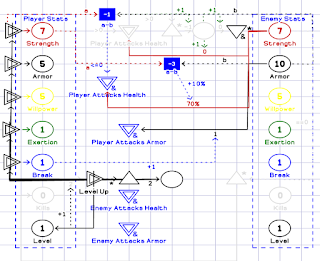
Each character has the same six stats: Ability, Armor, Strength, Willpower,
Exertion, and Break, but each has a different starting value and maximum value, in
addition to one different active ability and passive ability.
2.4 Procedures
2.4.1 Resolve Conflict or Talk to NPC
The player will spend a large amount of time resolving conflicts or talking to NPCs.
These dialogues could be purely for flavor, to add depth or realism to the characters
and the world they inhabit, or they could be mechanically driven, to create
diverging plot lines, or affect the player’s resources in some way. For instance,
following a battle in a city, the player might be faced with the choice of
recruiting some of the defeated enemies into their caravan, slaughtering them, or
leaving them to their fate. Each choice has a knock on effect to later parts of
the game experience. Slaughtering them will deprive the player of those
fighters later on, when their support might be critical. Allowing them to join
might spawn a whole host of conflicts inside one’s caravan as the two groups
struggle to coexist. The player will, of course, have to deal with those as they
arise.
2.4.2 Engage in Combat
The other major use of time in The Banner Saga is combat. Although many conflicts
can be resolved through dialogue choices, combat at many points is inevitable. The
player has the chance to decide which members will engage in combat, and
the order of their turns. Once in the combat screen, the player has a few
options for placing their party members before the blood starts flying. As
combat progresses, the player must gauge what the enemy AI is likely to
do, what their best response would be to negate that or to mitigate any
unavoidable damage. Archers and mages need to be placed in a sweet spot: close
enough to unleash their abilities, but far away enough stay out of harm’s
way.

2.4.3 Leveling Up
Leveling up a character grants the player two points to spend increasing their
stats. However, Renown must be spent to increase a character’s level, which
might be better used purchasing supplies, or convincing someone to do you a
favor.
2.4.4 Managing Health Conditions
If characters fall in battle, they are not killed (except in some extremely limited
circumstances). Instead, they enter a wounded state and must rest in a camp for a
certain number of days to heal. Being wounded brings with it deficits to a characters
Strength and other stats, which may make the character more of a liability than an
asset on the battle field.
2.5 Resources
2.5.1 Tangible Resources
- Party members: Party members hold many of the intangible resources listed below, but qualify as tangible resources since they may change location in the game world.
- Items: Items may be purchased from vendors, and stored in inventory or equipped on party members. These have level requirements and modify character stats.
2.5.2 Intangible Resources
- Strength: Strength functions as both health and damage in combat. When a character’s strength drops to zero in combat, the character is removed from combat and will enter an injured state when combat is finished.
- Armor: Armor blocks damage, so to figure out how much damage you will do to an enemy, simply subtract their armor from your strength. If the enemy has more armor than the character has strength, the damage is set to a minimum of 1 and the chance to hit the enemy is reduced 10% for each point of difference between your strength and their armor.
- Willpower: Willpower determines how many total extra action points the player will have during combat to increase movement range or boost the damage of an attack.
- Exertion: Exertion determines the number of Willpower points the player may spend at any given time. Increasing this stat allows the player to use more Willpower per action, but of course also uses up Willpower quicker.
- Break: Break is the amount of natural damage to armor. When the player chooses to attack armor, this determines how much the enemy’s armor will be reduced.
- Supplies: Supplies refer to food or water to feed the members of your caravan. The more clansmen, fighters, and varl you have, the more quickly your supplies will be drained.
- Renown: Renown is received by killing enemies in combat, completing NPC interactions with particular choices. As mentioned before, it is used both as currency to purchase items and supplies from markets, and as XP to level up characters.
- Morale: Morale determines the amount of willpower you have available for your characters in battle. It is itself determined by previous wins and losses, days spent resting, in a village, or out of a village, and certain dialogue choices and game events.
2.6 Conflicts
The overarching conflict in The Banner Saga is between the player’s caravan
members, who are struggling for survival, and the bandits and Dredge who seek to
kill them. Sometimes the bandits may become party members later on, but the
inhuman Dredge, who are encased in thick black armor which must be whittled
away before they can be killed, remain a constant threat throughout the
game.
2.6.1 NPCs
As in life, NPCs do not always say what they mean and even if they do, what they
want might directly conflict with the player’s goals.
2.6.2 Strength versus Armor
Both in terms of which the player decides to increase when leveling up, and in terms
of which to attack during combat, strength and armor represent a constant
trade-off. Increasing armor might mitigate damage, but it also limits one’s own
ability to do damage, while increasing strength increases both damage and
health, it does little to prevent the character from being knocked out during
battle.
2.7 Boundaries
Due to its limited scope, The Banner Saga features a large number of boundaries.
The number of NPCs that it is possible to interact with is severely limited and
controlled. The player might be able to interact with at most three NPCs at the same
time. These are mostly static images of characters with light animations during
the dialogue; outside of dialogue interactable characters are buttons with a
portrait.
In towns, similarly, there are at most three locations to interact with at any given
time. Towns are not explorable, but are instead mostly static backdrops with two
or three interactable buttons disguised as buildings scattered throughout
them.
The world map features a large number of locations which the player may click on
to gain more information about them and their history and lore, but outside of a few
dialogue choices, the player cannot influence where their party will progress to
next.
There are no money or loot rewards from battle, and similarly no upgrading your
character’s equipment and selling the old stuff.
2.7.1 Leveling
Characters may increase their level to 5, after which it makes more sense to have
lower level characters deliver the killing blow.
2.8 Outcomes
At the end of the game, there are two basic outcomes, but the player’s caravan may
be in several different states, depending on how long the player has spent traveling,
how well they have managed supplies, which NPCs they have helped and
how, etc. Losing a battle does not mean the game is over in most cases.
The player may lose some morale and have characters become injured, but
usually the game continues and the player must deal with the new negative
circumstances.
3 Dynamic Elements
Due to the boundaries mentioned earlier, The Banner Saga seems to feature limited
dynamic elements. There is no day/night cycle, no stealth, no crafting, there
are no political factions to align oneself with or to oppose. There are no
buildings to construct which lock or unlock unit development or research
branches.
With that said, there are dynamic elements in terms of combat affecting the
caravan’s morale and the caravan’s morale affecting combat. If the player
wins in combat and avoids injuries, the caravan’s morale generally increases,
which gives the characters a boost in willpower for the next combat. If the
player loses, this reduces caravan morale and may decrease the character’s
willpower in the next combat. The player’s performance in combat will also
determine the amount of injuries the characters sustain, which in turn will affect
the number of rest days needed to heal them, which will affect food and
morale (the later could be positive or negative, depending on where the player
rests).
There are further dynamic elements which are harder to quantify directly. The
player’s dialogue choices definitely affect the morale, amount of supplies, number of
warriors available to fight, and number of clansmen to feed. The problem is that it is
not exactly clear how these decisions affect them. The game shows you that after a
decision your morale has improved or worsened, but it is not clear why this is the
case, so the player cannot understand how to make better decisions in the
future.
3.1 Patterns
This section focuses on game patterns as discussed by Ernest Adams and Joris
Dormans in Game Mechanics: Advanced Game Design.
3.1.1 Dynamic Friction
The main quantifiable pattern is dynamic friction in the case of the increasing
number of kill and amount of Renown needed to level up a character.


4 Dramatic Elements
The dramatic elements are probably some of the strongest parts of The Banner
Saga.
4.1 Characters
There are a few dozen characters in The Banner Saga, and most are well-developed.
Many of them have a story arc over the course of the game, during which they
change and grow. There are Ubin, Hakon, and Iver, immortal varl who have seen it
all, Rook and his daughter Alette, who he tries to protect, Ludin, the prince to the
kingdom of men, who nobody really likes, and others.
4.2 Story
The story follows two caravans, led by Hakon and Rook, respectively, along their
journeys. They are both fleeing from Dredge, and the player must guide them to their
destinations. The player must decide how to do this, either by trying to help as many
fellow travelers as possible, leaving behind the old, sick and weak, being vicious to
outsiders while protecting one’s own, or by sacrificing one’s caravan for the good of
one’s fighters.
Eventually, Hakon’s group finds a mage named Eyvind, whose companion,
Juno, is at first believed to be dead. Hakon’s group and Rook’s group meet
in a city called Boersgard. There, Juno joins them and they find a way to
defeat the leader of the massive army of Dredge that threaten the lives of
all.
4.3 Attitude
The story contains some humorous elements but these are bleak and bitter. The tale
told is one of hardship endured, for no reward except to survive another
day.
5 Conclusion
The Banner Saga is a low-budget title which features interesting story-telling
mechanics and a few innovations on the tried-and-true turn-based combat from
isometric RPGs of yore. By forcing the player to make decisions and live with the
uncertain consequences, it creates the sensation of being a new leader, responsible for
the lives of those following you. Although limited in scope, it uses these decisions to
make the player care about the caravans struggling to get by in a disinterested and
sometimes openly hostile world.
Sunday, January 14, 2018
Particularly Wavy Rotation Update
Happy New Year!
Although one could certainly dispute the "happy" part, let's just take that as hopes that 2018 will be happy and leave it at that.
Before I left on vacation to Spain, which was wonderful BTW, I had noticed that my new rotation schemes were not entirely working. Which is to say that they were basically garbage and were broken. Well, after a dozen hours working on them, I can now say with some confidence that rotation works in Particularly Wavy. You can grab a rotatable object anywhere on its surface, and you will be able to drag and rotate it within its rotation range using the mouse. It is smooth and works fine. It does not matter where you grab the object, what its initial rotation is, or what the rotation range is: it just works.
For the rest of the week, the plan is to continue to design levels using prisms, as I have about 7 more levels which should utilize them. Following prisms, I have about 10 levels planned for filters and 20 levels for light splitters.
To support development, please check out my Patreon page and contribute.
Although one could certainly dispute the "happy" part, let's just take that as hopes that 2018 will be happy and leave it at that.
Before I left on vacation to Spain, which was wonderful BTW, I had noticed that my new rotation schemes were not entirely working. Which is to say that they were basically garbage and were broken. Well, after a dozen hours working on them, I can now say with some confidence that rotation works in Particularly Wavy. You can grab a rotatable object anywhere on its surface, and you will be able to drag and rotate it within its rotation range using the mouse. It is smooth and works fine. It does not matter where you grab the object, what its initial rotation is, or what the rotation range is: it just works.
For the rest of the week, the plan is to continue to design levels using prisms, as I have about 7 more levels which should utilize them. Following prisms, I have about 10 levels planned for filters and 20 levels for light splitters.
To support development, please check out my Patreon page and contribute.
Thursday, December 28, 2017
Particularly Wavy Update
hey all,
I have not gotten nearly as much work done as I wanted to this week. I've had more or less full-time work hours at my (kind of) paying job, which has greatly reduced the hours I can put into the game.
But what I have got done is this: I now have 41 puzzles complete and playable. The first 30 deal with reflection, while the next 20 (once completed) will deal with refraction. In that vein, I have removed a vicious set of bugs due to some recursive functions that I was using to deal with interior reflection inside a prism. These bugs at first caused Unity's garbage collector system to go haywire, with lots of errors spamming the console about "78 bytes allocated at " some random location, and after getting those to stop, I ran into a bug that caused Unity to simply crash. So, I was forced to greatly simplify the calculation of these internal reflections, since they could cause the light to bounce around inside the prism 5, 10, 20, or even 30 times before exiting, and Unity would have to deal with potentially 100's of game objects being created and destroyed each frame if the player was moving or rotating the prism.
I have also submitted the game to BitSummit 2018, which due to my excitement about going to GDC earlier this year I forgot to do for BitSummit 2017. I'll be updating everything I can about the game in terms of publicity before we enter 2018: the latest builds for 32-bit and 64-bit will be uploaded to BitSummit and to the game's page on itch.io, there will be a devblog on itch.io about the updates, and Twitter shall crash due to all the views and retweets about my amazing game, and as Wayne Campbell would say, "Cha, and monkeys might fly out of my butt!"
Well, in any case, I have actually updated my BitSummit submission, the itch.io version, posted the game to FaceBook and to Twitter, and YouTube. And I have spent more time than I care to admit tracking down database errors, problems loading and saving XML during runtime after compiling and building the game, making sure that Unity is properly saving the data about each object that I place and configure while I am designing the levels (which since I am using a number of custom inspector scripts, is actually quite difficult or at least annoying), and a host of other obstacles.
That is all the work I can put in on the game in 2017 and maintain my sanity.My wife and I will be out of Japan on a much deserved vacation until January 8th, 2018, so I will not be programming or designing anything. Although, like any other time, I will probably come up with a few ideas for prototypes, new games, and things while I am brushing my teeth, taking a shower, or staring into space or enjoying a view on our trip.
Peace and love to all my friends and family. If you had a great year in 2017, I hope 2018 knocks your socks off, and if 2017 put you through the wringer, I hope you put 2018 through it instead.
I have not gotten nearly as much work done as I wanted to this week. I've had more or less full-time work hours at my (kind of) paying job, which has greatly reduced the hours I can put into the game.
But what I have got done is this: I now have 41 puzzles complete and playable. The first 30 deal with reflection, while the next 20 (once completed) will deal with refraction. In that vein, I have removed a vicious set of bugs due to some recursive functions that I was using to deal with interior reflection inside a prism. These bugs at first caused Unity's garbage collector system to go haywire, with lots of errors spamming the console about "78 bytes allocated at " some random location, and after getting those to stop, I ran into a bug that caused Unity to simply crash. So, I was forced to greatly simplify the calculation of these internal reflections, since they could cause the light to bounce around inside the prism 5, 10, 20, or even 30 times before exiting, and Unity would have to deal with potentially 100's of game objects being created and destroyed each frame if the player was moving or rotating the prism.
I have also submitted the game to BitSummit 2018, which due to my excitement about going to GDC earlier this year I forgot to do for BitSummit 2017. I'll be updating everything I can about the game in terms of publicity before we enter 2018: the latest builds for 32-bit and 64-bit will be uploaded to BitSummit and to the game's page on itch.io, there will be a devblog on itch.io about the updates, and Twitter shall crash due to all the views and retweets about my amazing game, and as Wayne Campbell would say, "Cha, and monkeys might fly out of my butt!"
Well, in any case, I have actually updated my BitSummit submission, the itch.io version, posted the game to FaceBook and to Twitter, and YouTube. And I have spent more time than I care to admit tracking down database errors, problems loading and saving XML during runtime after compiling and building the game, making sure that Unity is properly saving the data about each object that I place and configure while I am designing the levels (which since I am using a number of custom inspector scripts, is actually quite difficult or at least annoying), and a host of other obstacles.
That is all the work I can put in on the game in 2017 and maintain my sanity.My wife and I will be out of Japan on a much deserved vacation until January 8th, 2018, so I will not be programming or designing anything. Although, like any other time, I will probably come up with a few ideas for prototypes, new games, and things while I am brushing my teeth, taking a shower, or staring into space or enjoying a view on our trip.
Peace and love to all my friends and family. If you had a great year in 2017, I hope 2018 knocks your socks off, and if 2017 put you through the wringer, I hope you put 2018 through it instead.
Subscribe to:
Posts (Atom)